When you’re choosing handmade jewellery, you might see the word hallmarking — and wonder what it means, when it’s needed, or why some pieces have it and some don’t.
As someone who crafts each piece by hand, I’d love to share what hallmarking is, why it matters and when it’s legally required.
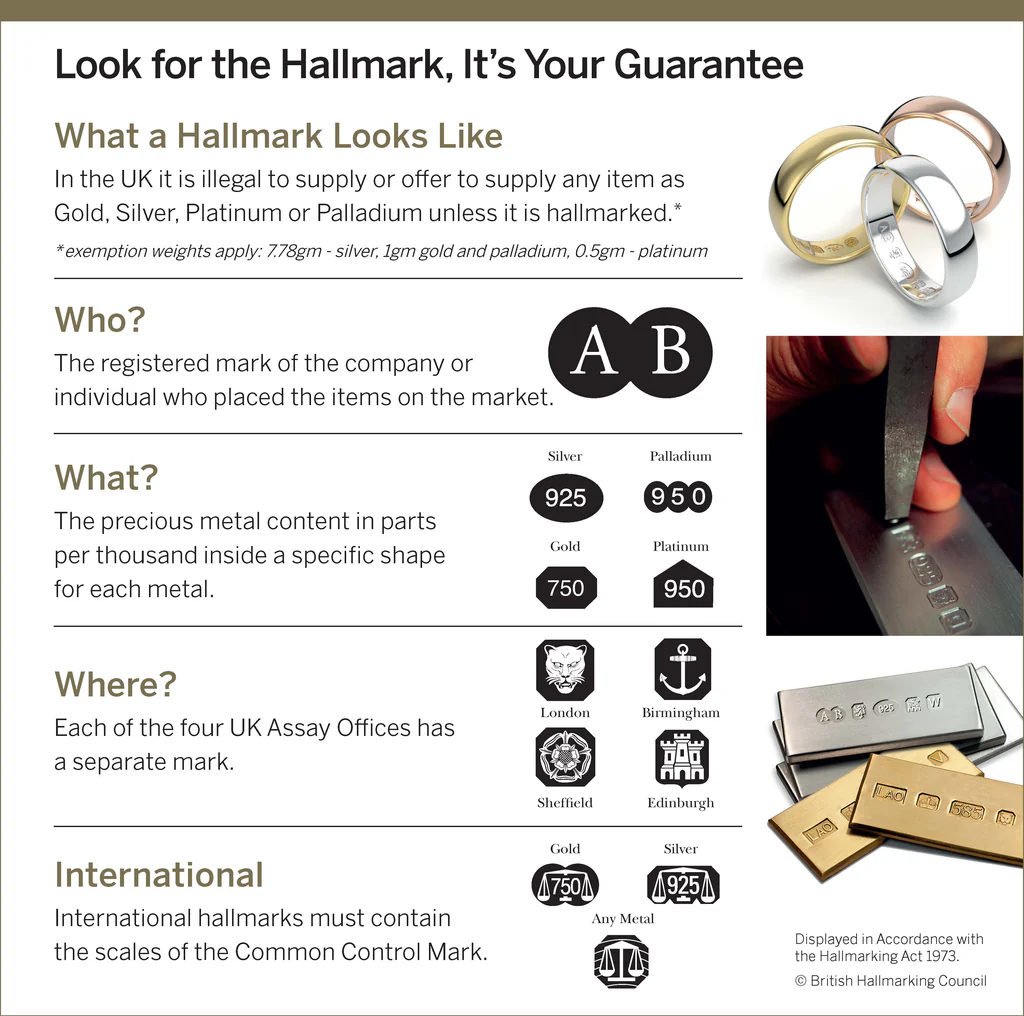
A hallmark is an official stamp applied to precious metal jewellery (silver, gold, platinum or palladium) to confirm its metal content. In the UK, this is done by one of four independent Assay Offices (London, Birmingham, Sheffield or Edinburgh) after they test the metal to make sure it meets the legal standard.
A full hallmark usually includes:
The Assay Office mark (where it was tested)
The fineness mark (e.g. 925 for sterling silver)
The maker’s mark (a unique stamp registered to me)
Optional marks like a date letter or commemorative mark
It’s one of the world’s oldest forms of consumer protection — giving you confidence in what you’re buying.
UK law requires hallmarking only for items over a certain weight:
Sterling silver: over 7.78 grams
Gold: over 1 gram
Platinum: over 0.5 grams
Palladium: over 1 gram
If a silver piece weighs less than 7.78 grams (as most of mine do), it doesn’t legally need a hallmark — though you can still choose to have one if you’d like.
My silver jewellery is handcrafted from solid sterling silver.
For smaller pieces under 7.78 g (which don’t legally need a hallmark), I had been personally stamping them by hand with my maker’s initials and a ‘925’ mark — showing they’re genuine sterling silver, uniquely made by me. However moving on, as from January 2026, every piece of silver jewellery will be hallmarked by the London Assay Office even when under required weight.
I send them to the London Assay Office for full hallmarking: official, independently tested marks confirming the silvers’ purity.
Hallmarking is a sign of trust and tradition — giving independent confirmation of the metal content.
For many people that extra mark can feel comforting.
Hallmarking confirms precious metal content, tested by an Assay Office
In the UK, it’s only legally required for silver items over 7.78 grams
Most of my jewellery is lighter, so hallmarking isn’t required — but I still do it.
Every piece is still made from genuine solid sterling silver, handcrafted with care
If you’d like to know anything more about hallmarking, please get in touch.
With warmth,
Tracy